
Stop Caring About Antisemitism
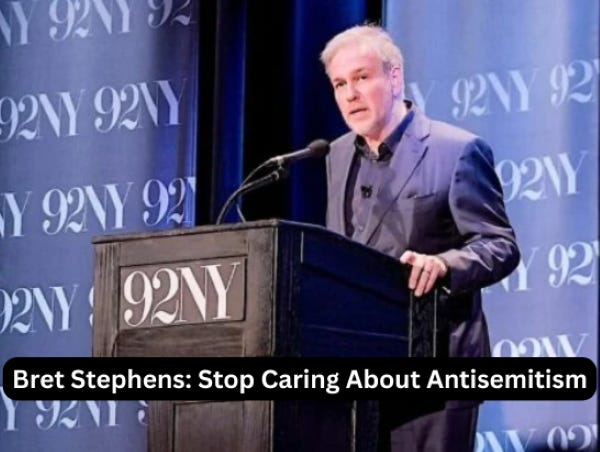
Bret Stephens nailed this in his State of World Jewry address

It’s strangely reassuring to hear someone widely respected say out loud something you’ve been thinking for years.
We have to stop caring about antisemitism.
That is essentially what New York Times columnist Bret Stephens argued in his recent State of World Jewry address at the 92nd Street Y. He will probably take plenty of heat for saying it. He may not be invited back. But on this point, he’s right.
Stephens put the mistake clearly:
“We think that antisemitism stems fundamentally from missing or inaccurate information… that if people only had greater knowledge… the hatred of us might dissipate or never start in the first place.
That thesis is wrong.
Jew hatred is not the result of a defect in education… Antisemitism… isn’t just a prejudice or a belief. It’s a neurosis.”
This has always been our error.
Throughout history we’ve naively confused the excuses for antisemitism with the real causes of Jew-hatred.
The Difference Between a Cause and an Excuse
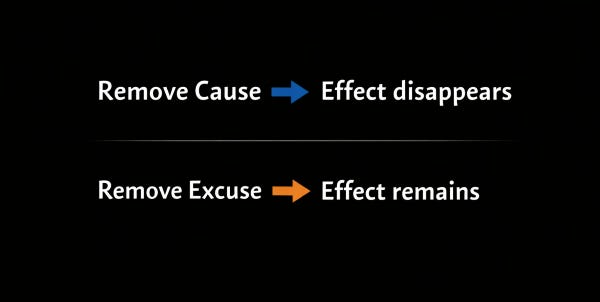
Whenever we look at a phenomenon, we need to distinguish between a cause and an excuse. The difference is straightforward.
If something is truly the cause, then remove it and the condition should disappear. But if it’s only an excuse, the problem will still be there even after the excuse is gone.
A child who is always late to school might say, “I don’t have a watch. How can I get there on time without a watch?” If his parents buy him a watch and he’s still late, then the watch was never the cause. It was just the excuse.
The same is true with antisemitism.
If we could actually identify the real cause, removing it should end the hatred.
But if we remove what we thought was the cause and the hatred remains, then we’re not dealing with a cause at all. What we’re looking at is an excuse that’s just masquerading as a cause.
Different Forms Same Hatred
Throughout history we’ve kept twisting ourselves into something we’re not, hoping to appease our enemies so the hatred would ease. It never does. Instead, whatever we reinvent ourselves to be simply becomes the new lightning rod the hatred attaches itself to. That’s because we keep believing the excuses for antisemitism and mistaking them for real causes.
For centuries they hated us because we were different. We ate differently, dressed differently, worshipped differently.
The response was the Reform movement.
Moses Mendelssohn and others believed that if Jews would just shed some of those differences, the hatred would disappear.
For a moment in 19th-century Western Europe, it even seemed to work. Jews rose into the highest levels of society. They entered prestigious universities, became doctors and lawyers, even lawmakers. If our differences had truly been the cause of the hatred, now that we dropped most of them, that should have ended antisemitism in Germany.
Instead Hitler arrived and taught us the opposite.
Now the Jew was no longer dangerous because he was different, but because he was too similar. Too integrated. Too close. A threat from within. From our self-mutation into a Jew at home and a German on the street was born the most lethal form of antisemitism the world has ever seen: racial antisemitism.
Here’s another example: for generations, Jews in the diaspora were hated as a supposed fifth column, a subversive nation within a nation. The obvious solution seemed to be a state of our own, which is exactly what the Zionist movement created. Did antisemitism end once we had a country? Not at all. Instead, the State of Israel and anti-Zionism simply became the new hatred du jour, the new excuse for the same old hostility.
Which means Stephens is right to say:
“For as long as there have been Jews, there have been Jew haters. And for as long as there will be Jews, there will be Jew haters.”
And if that is true, then this follows:
“The fight against antisemitism… is a well-meaning but mostly wasted effort. We should spend the money and focus our energy elsewhere.”
In other words, those who cannot live with the message the Jewish people were given to bring into the world, that there is one God who cares about human behavior and holds us morally accountable, will always seek to destroy the messenger. You cannot educate someone out of that resentment.
Our Job Isn’t to Convince Them
Our job is not to persuade the haters to stop hating us.
And the worst mistake we can make is to reshape ourselves in response to them and hope the hatred disappears. It won’t. It never does.
And again Stephens nails it:
“The proper defense against Jew hatred is… to lean into our Jewishness as far as each of us can… If the price of being our fullest selves as Jews is to be the perennially unpopular kids, it’s a price well worth paying.”
The Price of Being a Jew
It reminds me of an observation I once heard in the name of Rabbi Simcha Wasserman. He was commenting on the irony that it is often the less-affiliated Jews who lead the fight against antisemitism, while in the more observant circles they seem relatively untroubled. To explain this, he offered a simple parable.
Imagine two men walk into a jewelry store to buy a diamond. Each puts $20,000 on the counter. One receives a magnificent gem and leaves thrilled. The other is thrown out after his money is taken and receives nothing. Of course he will be enraged by the injustice forever.
Rabbi Wasserman’s point was simple.
There is a price to being a Jew. It’s called antisemitism. That price has always existed and always will. Fighting the existence of the price itself is wasted energy.
The real question is different:
Are you getting the diamond?
You will pay the price either way.
The more value your Judaism is adding to your life, the less antisemitism is going to bother you.
So the only rational response is to draw as much meaning, depth, community, holiness, and purpose out of Jewish life as possible. The less affiliated and invested someone is, the more unbearable the price feels. The more deeply connected someone is, the less power the hatred holds.
Case in Point
In a recent Channel 12 interview on Israeli TV, several former hostages described how they survived months inside Hamas tunnels. They spoke about hunger, fear, uncertainty. But what they returned to again and again was something else: the small fragments of Jewish life they managed to hold onto.
An improvised Friday-night gathering.
Homemade paper kippot.
Familiar melodies sung loudly enough to shake the tunnel.
Making blessings for food and water.
In other words, it was leaning into their Judaism and grabbing whatever dust of the diamond was available to them in that nightmare of the Gazan tunnels that gave them a desire to stay alive and push on.
One of them, a secular kibbutznik, said simply that anything connecting them to Jewish roots gave strength.
In their darkest moment, when the beast of antisemitism was unleashed, the only thing they could do was to lean as deeply into their Judaism, the customs and mitzvot, as humanly possible.
We will never convince the haters to leave us alone, and waiting for the world’s approval is an exercise in futility. Morphing ourselves into who were are not to hopefully meet the demands of a world that despises us will never be the solution.
What does make sense? Singing Shabbat songs in the darkness of a tunnel. Lightening a Chanukah candle when all hope feels lost. Choosing to make a blessing on a meager pita and water when there is almost nothing to be grateful for.
Trigger warning: This video is very hard to watch. But it shows six hostages lighting a Chanukah menorah in a tunnel in Gaza shortly before they were murdered. One of them is Hersh Goldberg-Polin. One is our neighbor, Ori Danino.
Stephens is right.
“Constantly seeking to prove ourselves worthy in order to win the world’s love is a fool’s errand…
The goal of Jewish life is not to ingratiate ourselves with others…
The goal of Jewish life is Jewish thriving.”
And that is the only victory that has ever mattered.
Thanks for reading,
David
PS - If you want one more amazing educational video to watch about the cancer of antisemitism, take five minutes and watch Rabbi Jonathan Sacks on the topic:
This piece nails a truth too many of us keep avoiding: antisemitism isn’t primarily a knowledge gap we can educate away — it’s a recurring, irrational hatred that will simply reattach to whatever excuse is handy. Trying to mollify it by shrinking or reshaping Jewish life only hands the haters new targets. Better strategy: deepen Jewish practice, community, and purpose
I like David Sack's little cartoon. He says it succinctly. The antisemitism du jour is genocide - but protests started even before the recent war. Genocide was an afterthought. Watching the Olympics, who can forget 1972 (everyone!) Yassir Arafat began his assaults on Israel long before the 6 day war. Anti-semites? I say f*ck 'em.